

Changelog
- Updated
- Updated
- Updated
Specialty running stores use content every day, oftentimes from their own staff. But what happens when the stores can’t get enough content, or don’t have enough people to make the content, or don’t have enough people who will edit and post the content?
The websites and social media feeds of specialty running stores are not specific and lack the emotion a runner has for an event.
You get the personalized service and experience from the staff that goes beyond a big box and Amazon.
Specialty running stores are already doing a lot of Instagram posts. You should be doing TikTok posts with that, and we could be doing YouTube Shorts. We can multipurpose all that video content that they’re using on Instagram on other channels. The video just needs to be repurposed. We can also use the text from Facebook ads and posts to repurpose on different platforms.
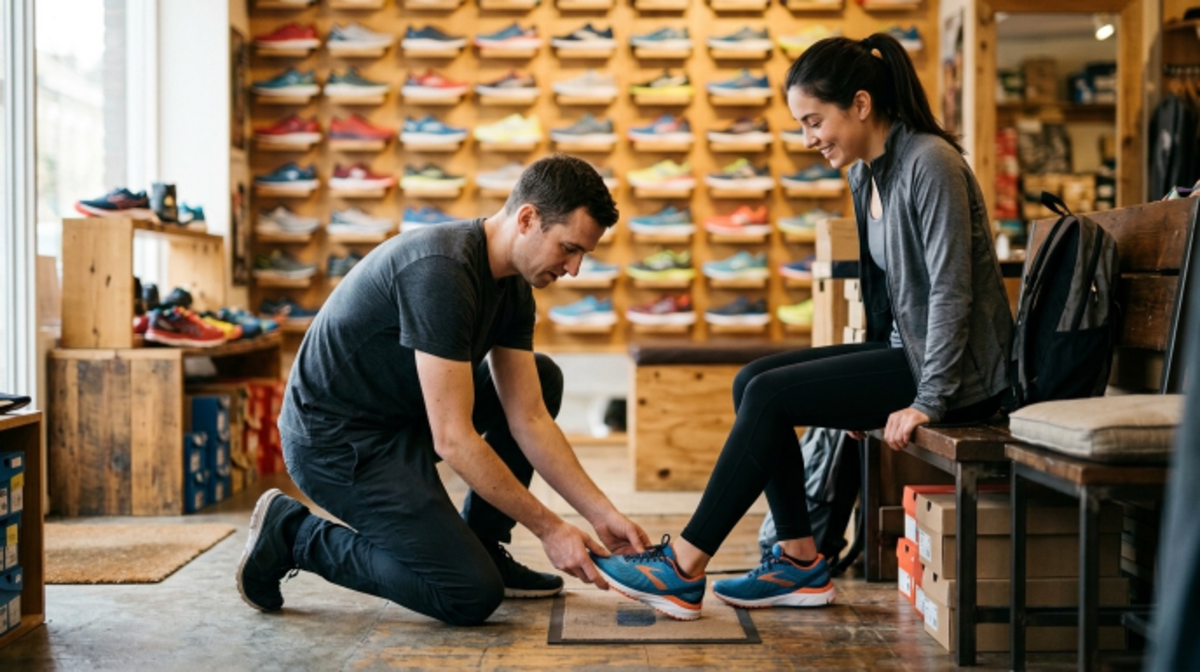
The fitting room example is good content to have for a store’s website, but nothing that is going to be recurring. We should focus on recurring content.
1. Email newsletters
Your email list is the one thing you own that you can continue to communicate with your clients. Instagram, TikTok, any social platform can shut down, or shut you down, for whatever reason. Who knows, someday there’ll be a complete running ban across some country. That was a joke. The runners on the list have opted into the list, so the runners have more identification with the store and a need and a want to get the information from the store.
A store owner should do a monthly newsletter with all the news from around the region, including the store’s run group and upcoming races.
Your email newsletter is the best place to start for recurring content. At least once a month, if not sooner, and periodic sales or clearance items can be put into an email.
2. Instagram, TikTok, and YouTube Shorts
Videos, pictures of events, and race photos. I would encourage your staff and your customers to send in photos, even create a contest with your running store shirt in different parts of the world, all sorts of ideas that can happen on Instagram. A video a store posts on Instagram goes on multiple channels, maybe in a different way, in a different light, in a different format, with some different wording.
TikTok Shop is growing like crazy. You want to sell that running shirt across town? You can hyper geofence your TikTok ads to sell products in your city to people you want to sell to.
TikTok reaches the demographic that doesn’t watch Instagram.
YouTube Shorts are a great way to experiment on short-form video, even taking some of your long-form video and chopping it up into short-form, and posting the short-form video on YouTube. Make sure you have your descriptions and your titles ready to search. YouTube is the second largest search platform in the world.
Instagram, TikTok, and YouTube Shorts each add a different dimension for their own demographic.
3. Facebook posts and ad copy
Similar to TikTok, Facebook allows you to hyper-focus on specific users who are in your vertical or in your geo. You can use Facebook posts and Facebook ads to target customers you want to reach. You can also use Facebook simply for groups and for reposting content from your clients and your staff.
4. Local race guides and course previews
You could review the course elevation. You and the staff can talk about the type of shoes the staff wear for the course, what the racing shoes are that are popular, what the crowd is going to be like, and where to see the cheer section. If your store is big enough, you may have a cheer group on the course.
A specialty running store can talk about nerves, preparedness, shake out runs, nutrition, hydration, tapering in the final two weeks, race morning routine, what to wear for the forecast, pacing plan, packet pickup and parking, aid station locations, and recovery after the finish.
5. Group runs and Strava club events
Strava also offers places to do blog posts, so a Strava club post is another option.
A store’s Strava club is connected to the running community. A Strava run club event is also easy to create.
I wouldn’t necessarily say a store needs a page for every group run. A store needs a page for all its group runs, unless the store has a lot of group runs. Encouraging members to post about their run, and even embedding members’ Strava feeds into the group run page, would be interesting.
It is also important for a group run page to say things like, “This is a no-drop run, we support all paces, we don’t turn away people, we are inclusive.”
A runner at a store’s group run feels welcomed, and runners at any pace are welcomed into the group.
6. Training program updates
A running store should be very communicative about what runners should expect. On a Couch-to-5K, the runner should know the runner is going to be walking in the very beginning. If the runner is doing a marathon group training, then pace is important and some base is important, so some one-on-one information, and the schedule, is the schedule a 16-week training plan? There’s all kinds of communication that has to happen up front, and the Couch-to-5K is completely different than a marathon training.
A running store tells a new runner, “You can do it, don’t worry about speed, you can finish.”
7. Event pages for demo nights and brand visits
Shoe demo nights are a great opportunity for members and guests to try on shoes from the brand that is giving the demo. Typically a brand will bring one or two pairs in every size for people to try. Members and guests can go out for a run, and the rep will often also go out for a run. A shoe demo night is a great opportunity for the store owner to promote the brand and the store and the shoes.
A shoe demo night or a brand rep visit can be an event like a special group run.
8. Shoe fitting and gait analysis videos
A shoe fitting is such a personalized experience that it’s hard to explain on a blog post.
Getting local customers to give some testimonials of their shoes and the success they may have had in a race is also good content.
A specialty running store needs to talk about the importance of having an expert help with shoes.
9. Google Business Profile posts and reviews
A store’s Google profile should show as much as the store can. The store should be filling out all the information that Google asks for, and update the store hours and everything else in the Google Business Profile.
For ChatGPT, Claude, Gemini, and Google, I would start with our audit, and have our audit tell us what things and where the store is being seen. Until we do the audit, we can’t tell the store what to do, until we find the data. So the first thing I would say is we need to perform an audit to find out how the store is being seen.
Google lets a business add three kinds of posts to a Business Profile, updates, offers, and events, and posts older than six months are archived unless a date range is set.
10. Product pages, staff picks, and shoe guides
An employee picks a product because the employee believes in the product, not because of some incentive a big box store has to sell a product.
First, it’s important that the runner is healed, and the running store does not give the runner medical advice, but the running store can give the runner the best type of shoes for whatever the runner’s feet need. The answer may be insoles, the answer may be some kind of wide shoe or flat shoe. The running store has a great opportunity here to help the runner.
A lot of runners don’t know what to ask, so it’s up to the shoe person at the running store to suggest the right questions to ask. A shoe guide is as much for inexperienced runners as it is for experienced runners, and I think inexperienced runners are often overlooked.
How does Content Cucumber help a specialty running store?
The founder and the CEO of Content Cucumber are both runners, and we have run lots of marathons and lots of races. We know what runners need, and we can help any specialty running store boost the store’s sales. We are experienced in e-commerce and marketing and running. We will help with TikTok ads.
A human points to the finish line and the goal post. An AI agent never pushes forward, because the AI agent does not have unique thoughts.
I wrote this post with editing and spelling help from Claude.
Human writers. True story.
Explore our writing services
Content Services →Keep Reading


Frequently Asked Questions
Your email newsletter is the best place to start for recurring content. Your email list is the one thing you own that you can continue to communicate with your clients.
I would start with our audit, and have our audit tell us what things and where the store is being seen. Until we do the audit, we can't tell the store what to do.
This is a no-drop run, we support all paces, we don't turn away people, we are inclusive.
You can do it, don't worry about speed, you can finish.
