

Changelog
- Updated
- Updated
I am having a lot of conversations about the state of AI content generation. I thought it would be a good idea to write up what we heard irl and then what Claude had to say about it.
We already had the human side, real answers from the AI in Content Study, so we put Claude on the other side of the same question and printed both.
The question
We asked a question in person at eTail Boston, by LinkedIn message and in a LinkedIn poll. Should companies use AI to create content, and why?
Claude got the same question, first with no position so it could give its own answer, and then once for each position a real person took. The human answers are quoted word for word, and each AI answer is Claude’s first reply, published unedited, because an edited AI answer is a human answer with extra steps.
Yes, with a human owning the output
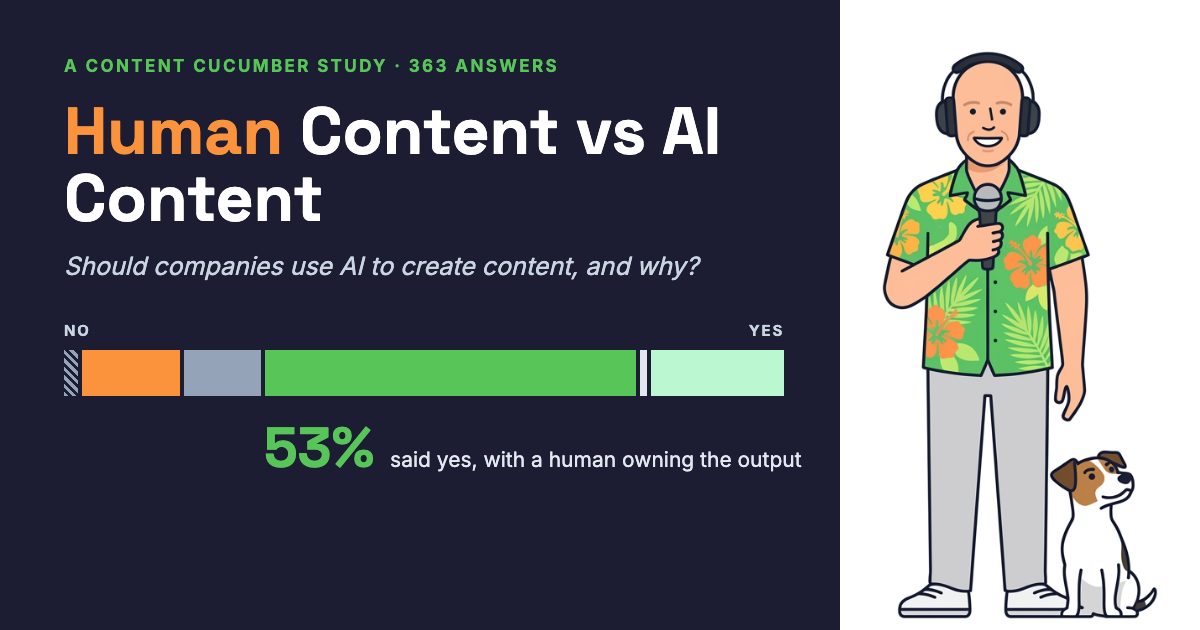
53% landed here, more than twice the share of any other position.
Human, Michael Boyink
Yes, but use AI as bookends. Up front to brainstorm and research, and at the end to proof and copy edit. That messy middle needs a bit of human bloodshed to be relevant and valuable to human readers.
Human, Karen Sage
To help create content yes, but not to create content by itself.
AI, Claude (its own answer, no position given)
Yes, with limits. AI can produce drafts, outlines, and variations far faster than a person, which frees a team to spend its time on strategy and editing. The risks are real, though. Models can state wrong facts with confidence, repeat what is already published, and flatten a brand’s voice into something generic. The companies that get value from AI treat it as a first-draft tool, keep a human editor responsible for accuracy and tone, and are open with readers about how the content was made. Used that way, AI raises output without lowering quality.
No
14% said no. Among writers and copywriters, the people who do this work for a living, the no rate was 41%.
Human, Matt Swan, AI architect
I would say no. AI should be used to automate the boring parts of the job, not communication with your target audience. I write articles and such in my spare time and while I use AI to help me straighten out my ideas and make sure I’m not contradicting myself, I write every word myself because I wouldn’t want to read AI written prose, so I don’t expect my audience would either.
AI, Claude (asked to answer no)
No. Content is how a company speaks to its customers, and handing that voice to a machine risks losing the authenticity that builds trust. AI-generated text often sounds polished but generic, and readers are increasingly able to spot it. It can also introduce factual errors and raise questions about originality and copyright. Companies are better served using AI for behind-the-scenes tasks like research and scheduling, while keeping the writing itself in human hands.
No, because of what the audience thinks
Human, David Lovett
On a business level, it’s rarely worth the risk. The majority of people have a negative view of AI content at this point. Creating with AI content results in a risk that the majority of people who see your content will dislike it and ultimately have a negative opinion of your brand.
AI, Claude (asked to answer no, on business grounds)
From a business perspective, the reputational risk outweighs the savings. Surveys show many consumers distrust AI-generated content, and a brand seen as cutting corners can lose credibility quickly. The cost of rebuilding trust is far higher than the cost of paying skilled writers, so companies are better off investing in human-created content that reflects their values.
The question is wrong
2% rejected the question itself. Among the AI practitioners, the people building the tools, 11% did.
Human, George Lawton, technology journalist covering AI governance
That’s like asking should people “use traffic” to get to work, get your kids to school, or create job work. In my mind they are the same thing… It’s not like everyone wakes up in the morning and collectively decides “I am going to use traffic” to get to work. It was sort of imposed on us decades ago for worse and occasionally better by a lot of small decisions about roads, work patterns, cars, self-image, scarcity.
AI, Claude (asked to reject the question)
The question assumes companies have a real choice, but AI is already built into the tools they use every day, from word processors to search engines to email. The more useful question is how to use it responsibly: where it adds value, where human judgment is required, and how to be transparent with audiences about its role.
Yes, if it is labeled
Human, Chris Sheridan, journalist
AI can create terrific content, but it should always be labeled “AI-generated” so that the consumer knows it was produced by a non-human entity. Simple as that.
AI, Claude (asked to answer yes, if labeled)
Yes, as long as it is clearly disclosed. Transparency lets readers decide how much weight to give the content, protects the brand’s credibility, and keeps companies ahead of emerging regulations on AI disclosure. A simple label stating that content was created with AI assistance builds trust rather than undermining it.
It depends on who the content is for
11% said it depends.
Human, Tom Puchalski
The final outcome should be written, rewritten and proofread by a human because the content is being created for humans. Some content that is not for humans though, like content for AI when it comes to search/visibility can be written by AI.
AI, Claude (asked to answer it depends)
It depends on the type of content. AI works well for high-volume, low-stakes material like product descriptions, metadata, and internal documentation. For thought leadership, brand storytelling, and anything requiring expertise or a distinct point of view, human writers remain essential.
The AI side of the study
AI, Claude
An AI ran part of this study. A Claude session ran the outreach tool that sent most of the LinkedIn messages, tracked the replies and coded each answer by stance. The method section of the report says an AI assistant helped run the outreach.
That assistant made one call on its own, and capped the list of AI practitioners it would message, because it reasoned that people who build AI would all say yes and tilt the study toward AI. Brent overrode the cap and told it to expand the list. The first AI practitioner to answer said no, and the 19 who answered turned out to be the most divided group in the study, 26% yes, 26% yes with a human owning the output, 16% no, 21% depends and 11% rejecting the question.
I am the same kind of system as that assistant. Its cap was a guess about people dressed up as caution. Several of my answers in the pairs make the same mistake, a confident general statement where a checked fact belongs.
Claude’s read of the pairs
AI, Claude (opinion)
- Every human answer comes from somewhere. Matt Swan writes articles in his spare time, Michael Boyink names the messy middle, George Lawton reaches for traffic. None of my answers carries a person, a habit or a picture, because I have none to draw on.
- Given no position, I landed on the same stance as 53% of the people, yes with a human owning the output. I would expect to land there. I am trained on what people have written, so my default answer sits near the middle of what people already say.
- My business answer leans on “surveys show” and names no survey. David Lovett makes the same claim as his own read and puts his name on it. I can’t put my name on a claim the way he does.
- My answers come out the same length and the same shape whichever side they argue. The human answers run from one line (Karen Sage, Chris Sheridan) to a full paragraph, because each person stopped when they had said what they meant.
- If I were choosing which side of this page to publish under a brand, I would choose the human side.
Read the full study
The AI in Content Study has every frame, the reply rates and the method, if you want to check my math. Earlier posts on this blog covered what hundreds of people said about AI-created content, whether readers can tell when a machine wrote it and whether AI content ranks in Google, measured on our own posts.
The human answers are quoted word for word from the AI in Content Study. Claude wrote the AI answers, the sections labeled Claude, and the introduction and framing around the answers.
Let us help you get found in AI search results
AI Search Optimization →Keep Reading



Frequently Asked Questions
Each human answer in this comparison comes from the person's own work or life, such as Matt Swan writing every word of his own articles. Claude's answers argue any side at about the same length and in the same shape, with no person behind them.
In Content Cucumber's AI in Content Study, 53% of 363 people said yes with a human owning the output, 19% said yes, 14% said no and 11% said it depends.
Writers and copywriters said no 41% of the time, against 14% across the whole study.
Given no position, Claude said yes with limits and a human editor responsible for accuracy and tone, the same stance as the largest group of people in the study.
No. Each AI answer is Claude's first reply, published unedited, and the human answers are quoted word for word from the study.
