
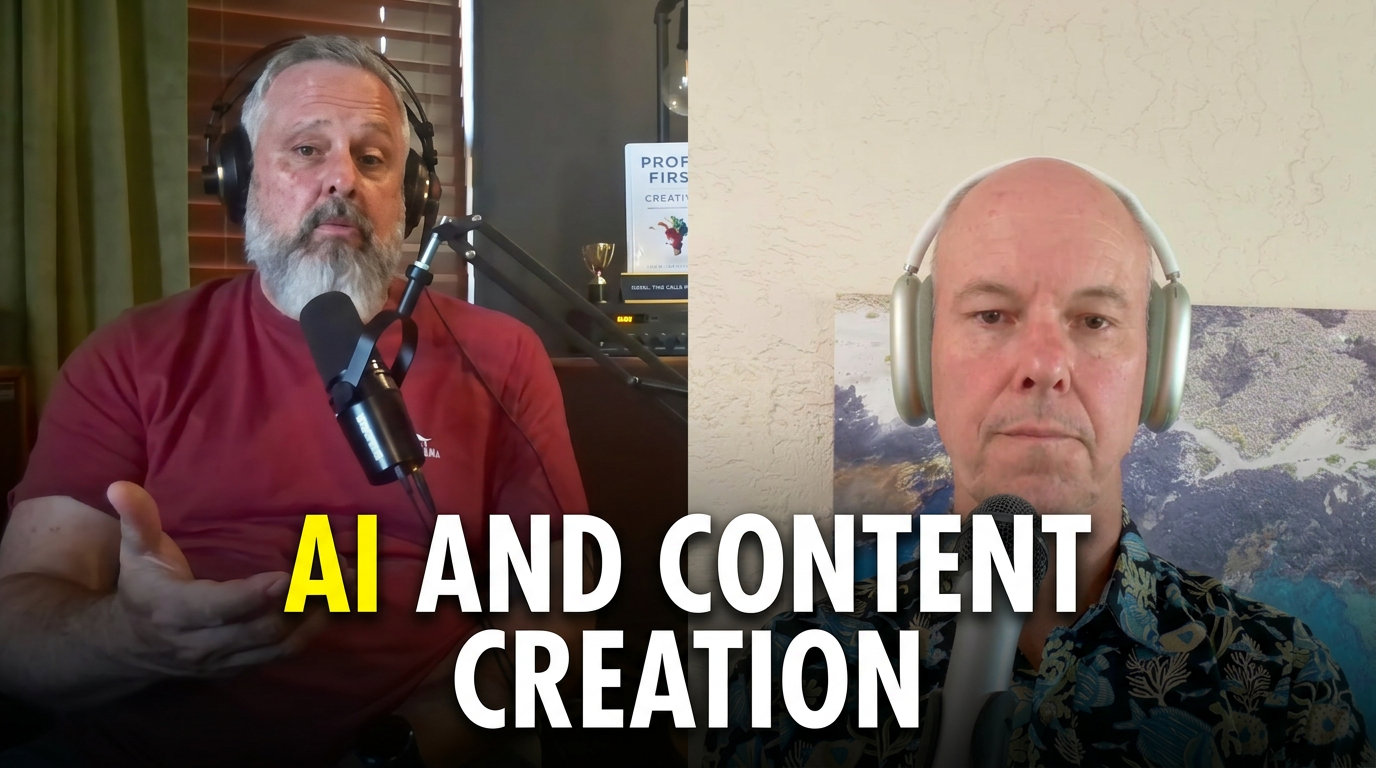

I sat down with Christian Brim on his podcast, The Profitable Creative. Christian runs a show focused on helping creative professionals turn their skills into sustainable businesses. Our conversation landed right in the middle of something I think about every day. The relationship between human writers and AI tools.
I wanted to expand on a few things we talked about.
How I Ended Up Running a Writing Company
Content Cucumber has been around since 2018. A bunch of college kids started it, and we were one of their first clients back when I ran Wagento, an e-commerce integration company built on Magento. I knew the founders for years. One of them, Isaac, is still my business partner.
I bought Content Cucumber in April 2025 because I saw something most people were missing. The company does something radically innovative. We have human beings who write content for other human beings.
That sounds like a joke. It is not. Since ChatGPT launched, writers have been decimated. It felt like a plague sweeping through the industry, and writers took the first hit. My goal was to find places where writers can still do what they do best, and change how the inefficient parts of the work get done.
The Content Basis Experiment
Before Content Cucumber, I started a company called Content Basis in 2023. It was AI-forward. Think of it like whiskey-forward at a malt bar, except with AI. A human stayed in the editing loop, but AI did the heavy lifting on first drafts.
I launched it right around when ChatGPT came out. I ran it by my forum mates in Entrepreneurs’ Organization and they told me not to even mention AI. This was pre-ChatGPT hype. “Don’t talk about it,” they said. Then once ChatGPT took root in 2024, the advice flipped completely. “Lean into it. Tell people you’re saving them money with AI.” So I did.
Three years of running that experiment taught me things I did not expect.
People recognize AI content. There are tells. Patterns. Phrases that show up in every AI-generated piece. Once you see them, you cannot unsee them. And your readers see them too.
The speed was a trap. Clients wanted their content in 30 seconds. They did not want to edit it. They did not want to read it before publishing. We had a ton of new clients at first. Then they realized AI is not a magic box. You still need to read what it produces. You still need to edit it. That takes time. Maybe not as much time as writing a thousand-word post from scratch, but it is not the “press a button and walk away” experience people were sold on.
And then there is the sameness problem. When everyone uses the same tools with the same defaults, every company starts sounding identical. Christian nailed this with a Marvel analogy during our conversation. If you have seen one Marvel movie, you have seen them all. That serves a certain audience. But the 20% who want something with depth, something that connects on a human level, they are not going to find it in AI-generated output alone.
Where AI Earns Its Keep
None of this means I am anti-AI. I am a heavy Claude user. I am a crazy person who dives into all kinds of technology to make content better. I built RequestDesk, a tool that stores your brand in a database so any content (human-written or AI-assisted) checks against your brand voice. I even maintain a database of overused AI terms that catches words like “delve” before they make it into a final draft.
Where AI earns its keep is in the work that used to eat up a writer’s whole afternoon. Research and citations. Pulling together sources, summarizing long documents, finding the data point you need buried in a 50-page report. AI is faster at that than any person, and often more thorough.
The editing side is where I get the most value personally. I write something, then I have a prompt that applies my brand voice to the draft. It counts the adverbs (LLMs definitely overuse them), gives me a grid showing each one, and tells me whether it thinks the adverb is earning its place or dragging down the sentence. Every book has an editor. A well-trained LLM fills that role alongside a human one, and it never gets tired of reading your fourth revision.
Christian asked me about the unpredictability of LLM outputs, and he is right to bring it up. Some days your LLMs are completely stupid and you are wondering what is going on. The next day they are the smartest thing in the world. We inject products into Shopify blog posts, and unless you scaffold the code with templates and rules, it works right about 80% of the time. Or as I like to say, it works right 90% of the time and wrong 20% of the time. The math does not add up, and neither does blind trust in AI output.
The Trust Gap
Christian pointed to something bigger than just an LLM problem. There is a growing backlash against technology-driven content in general. People sense when something is inauthentic. He compared it to the difference between a programmatic Marvel movie and Schindler’s List. One serves a function. The other connects.
I got into AI-generated art for a while. Creating images with tools like Midjourney is genuinely a skill. You need to know how to prompt, how to iterate, how to coax the thing into giving you what you see in your head. But once people learn the art was AI-generated, they stop caring. The creative effort behind a good prompt does not register the way brushstrokes do. It is similar to what happened when Photoshop arrived and people thought all the old design jobs would disappear. They did disappear, and then Photoshop became the way everyone did graphic design. We are in that same arc with AI content, but we are not through it yet.
At e-commerce conferences, I keep hearing the same thing from vendors. Their audiences recognize AI-generated content. And when your writing style sounds exactly like your competitor’s because you both used the same tool with the same defaults, you do not have a content strategy. You have a brand problem.
AI slop (that is what people call it now) does not build trust. It does not build anything.
Podcasting and the Content Flywheel
Christian asked how podcasting connects to the content we produce at Content Cucumber. Honestly, it took me an embarrassingly long time to connect those dots myself, and I have been doing a weekly podcast since 2021. I originally started it as a creative outlet after going from being the boss to having a boss, and that transition was rough. But I learned more from interviewing guests every week than I would have learned in years of just reading about the industry.
Podcasting gets what is in your head out into the world in a way that writing alone cannot, especially if you are not a natural writer. A conversation pulls out ideas you did not know you had. Christian made a great observation about the format itself. When someone commits to 30 or 45 minutes of listening, their brain goes to a different space than scanning a blog post for four minutes. It is not just processing information differently. You have given it room to think.
That is exactly the philosophy behind our Flywheel Plan at Content Cucumber. We do a monthly interview with each client to capture their voice, their ideas, and their expertise. Then we turn that raw material into blog posts, newsletters, social media content, and strategy. The flywheel spins. Basic content feeds into more refined content, which feeds into discovery through SEO, which feeds into more conversations.
We pair that with Google Search Console data to understand which topics are resonating and where the opportunities are. If a product sits on page 100 of Google, we can build a content strategy to move it to page eight, then page one. The only way to get there is through content. Letting products sit with less than a hundred words on a page (which is the Shopify default for most stores) was never going to work, and it works even less now.
Humans Might Be the Problem (and That Is the Point)
Christian raised the self-driving car analogy, and it stuck with me. There is a Malcolm Gladwell podcast about how humans might ruin the self-driving experience. Self-driving cars watch for pedestrians 100% of the time. They stop for people walking in the middle of the road. Humans behind the wheel are unpredictable, impulsive, emotional. We are the variable that breaks the system.
Apply that to content and something interesting happens. AI is consistent but convergent. It gives you what everyone else has already done. Christian said it directly: “It is reductive. Inception, original thought, has to come from a human.” He is right. AI cannot come up with a new idea for you. It can tell you how you have done it the last 20 times, but it cannot break the pattern.
Human writers are inconsistent. We are divergent. We go on tangents about pinball machines and somehow circle back to a point about authenticity. We say things that are, as I told Christian, completely not AI. You cannot explain it. And that is exactly what makes it valuable.
AI handles the repeatable, the structured, the analytical. Humans bring the thought that nobody saw coming. The best content happens in the tension between those two.
Put It to Work
I run an e-commerce content company. After this conversation with Christian, I keep coming back to a few things.
AI is not a replacement for writers. It is the best editing partner a writer has ever had, and a fantastic research assistant, and a terrible replacement for an original voice. If you treat it as a shortcut to skip the human part, your content will sound like everyone else’s. That is not a hypothetical. I have watched it happen across the industry for three years.
The other thing I took from this conversation is how undervalued strategy is compared to production. Writing SEO-friendly content and having an SEO content strategy are two different things. Most e-commerce brands have the first one. They write blog posts with keywords. Very few have the second one, where someone is looking at Google Search Console data, identifying which products sit on page 100, and building a plan to move them forward through content that compounds over time.
And then there is the conversation itself. This podcast episode with Christian will turn into a blog post (you are reading it), social content, newsletter material, and probably a few ideas I have not thought of yet. A single 30-minute conversation, when you have the right process to capture and refine it, can fuel a month of content. That is the flywheel. That is what we build for clients.
I had a great time talking with Christian on The Profitable Creative. If you want to hear the full conversation, check out his podcast wherever you listen.
If your business needs content that sounds like your brand and not like everyone else’s, take a look at our Flywheel Plan. We pair human writers with smart AI tools to build a content engine that grows with you.
Let us help you get found in AI search results
AI Search Optimization →Keep Reading



Frequently Asked Questions
The editing side is where I get the most value personally. I write something, then I have a prompt that applies my brand voice to the draft. It counts the adverbs (LLMs definitely overuse them), gives me a grid showing each one, and tells me whether it thinks the adverb is earning its place or dragging down the sentence. Every book has an editor. A well-trained LLM fills that role alongside a human one, and it never gets tired of reading your fourth revision.
