
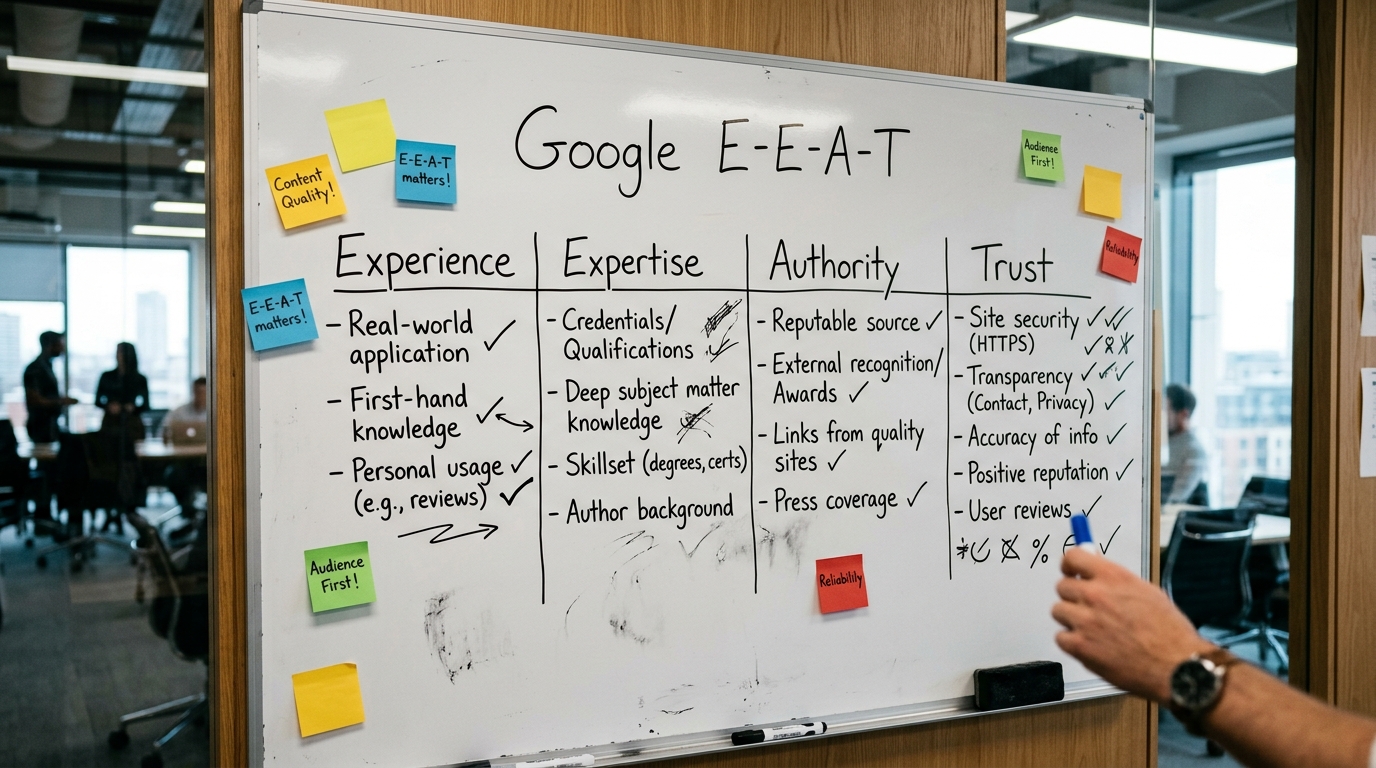

Google added the extra E to E-A-T in late 2022. Experience, Expertise, Authoritativeness, Trustworthiness. Most people already know what the letters stand for. What most people do not know is how much harder these signals are to earn in 2026, and why the brands still treating E-E-A-T as a checklist are losing ground.
I run Content Cucumber. We have 40+ human writers. I have spoken about content strategy at eTail, Meet Magento, and ShopTalk. I have watched this framework reshape how Google evaluates content over the past four years. Here is what I have learned, including the parts that are not comfortable to talk about.
The 60% Problem
Before we get into the framework, you need to understand the landscape it operates in.
According to recent search industry data, roughly 60% of Google searches now end without a click. AI Overviews push organic results down. Click-through rates drop 15-64% when those summaries appear (per SparkToro and Datos research). For how-to queries, the decline hits 30-60%.
The traffic that does click through is different than it was two years ago. These are people who want to verify something, go deeper, or take action. They are not clicking for definitions. They already got the definition from the AI summary.
So the content that earns clicks in 2026 has to offer something the summary cannot. Real experience. Specific data. A perspective that comes from doing the work, not from synthesizing what other people wrote about doing the work. E-E-A-T is how Google measures whether your content has that.
Experience Is the Hardest One to Fake
I will start here because this is where the framework changed the most in 2022, and it is the one that AI content struggles with the most.
At Content Cucumber, we work with Silicone Depot, a supplier of silicone sealants and caulking. They started publishing weekly articles with us in 2018. At the time, they had roughly 500 organic visitors per month. Today they average over 10,000. That is 20x growth over seven years.
The growth did not come from keyword stuffing or publishing volume alone. It came from our writers learning the product category. They learned the difference between acetoxy cure and neutral cure silicone, and which products work in wet environments and which ones fail. That depth of knowledge shows up in the writing, and Google rewards it.
We saw something similar with Chalet Market, a Montana-based provider of premium meats and specialty foods. Their Shopify store traffic was flat. We started a weekly blog strategy with product spotlights, recipe content, and stories about their local ranching partnerships. Traffic went up 105%.
The Chalet Market content works because our writers understood the difference between buffalo salami and traditional salami, the nutritional case for elk versus bison, and why the sourcing relationships with Montana ranchers matter to the customer. A generic AI article about “gourmet meats” would never go that deep. It has never tasted the product. It has never talked to the rancher.
AI has no experience. Compiling and summarizing is not the same as knowing. Google added Experience to the framework for a reason.
Expertise Without a Body of Work Is Just a Claim
Anyone can call themselves an expert. Google looks for proof.
Author credentials matter. Track record matters. But the signal Google cares about most is whether the site has a body of work on the topic. One blog post does not make you an expert. A hundred blog posts over three years, covering every angle of your product category, starts to.
Silicone Depot’s content library is a good example of what this looks like in practice. They did not publish one article about silicone sealants and move on. They published every week for seven years. Every product, every use case, every customer question. That consistency is an expertise signal that no single piece of content can replicate.
I think Google gets some of this wrong, by the way. A small business owner with 20 years of hands-on experience and no blog posts has more expertise than a content farm with 500 AI-generated articles. But Google cannot read minds. It can only read content. So the expertise has to show up on the page, attributed to a real person, backed by a track record. Unfair? Maybe. But it is the system we are working in.
Authority Comes from Outside Your Own Site
You cannot give yourself authority. Other people give it to you.
Backlinks from industry publications. Mentions in trade media. Being cited in someone else’s article as a source. Speaking at conferences. These are all authority signals, and they take time to build.
Talk Commerce (our podcast) has featured over 500 episodes of ecommerce conversations. Those episodes create authority signals across YouTube, Apple Podcasts, Spotify, and dozens of guest websites that link back. The podcast itself is not an SEO play. But the network effect of 500+ conversations with ecommerce leaders compounds into authority that Google can measure.
If you are an ecommerce brand trying to build authority, start with what you have. Client testimonials with full attribution. Partnerships with recognized platforms (Shopify, BigCommerce, HubSpot). Guest posts in your industry’s publications. None of this is fast. All of it matters.
Trust Is the One That Can Sink Everything Else
A site can have experienced, expert, authoritative content and still fail on trust. Missing contact page. No author attribution. No privacy policy. Broken SSL certificate. These are table stakes, and Google treats them that way.
I have seen sites with great content get penalized because the “About” page was a single paragraph with no names, no photos, and no contact information. Google’s Quality Rater Guidelines are explicit: they look for “who is behind the content.” If the answer is unclear, trust drops, and everything else drops with it.
The fix is boring but critical. Named authors with bios. A real address and phone number. Clear privacy and terms pages. HTTPS. These are not differentiators. They are prerequisites.
What Happened When ChatGPT Showed Up
I need to be honest about something.
When ChatGPT launched, Content Cucumber lost 80% of our business. Clients left because they believed AI could replace human writers at a fraction of the cost. I am not going to pretend I know what happened to all of them. Some may be doing fine. I genuinely do not know.
But I do know the data. According to a Graphite study, 86% of content ranking on page one is still human-written. Google’s March 2025 core update caused 40-60% ranking drops for sites that relied on AI-generated content without human oversight.
I already made the point about experience earlier in this article. It applies double here. The Silicone Depot and Chalet Market results came from writers who learned the category. No AI model learned those categories. No AI model ever will.
We use AI at Content Cucumber for research, outlining, and draft acceleration. The experience, the voice, and the editorial judgment come from our writers. AI is a tool. E-E-A-T requires a human behind the tool.
The hard part is that clients do not always see this distinction until their rankings drop. By then they have spent six months publishing AI content that looked fine on the surface but had no E-E-A-T signals underneath. Rebuilding from that position takes longer than building it right the first time.
What to Do About It
Fix your author attribution first. Not “Admin.” Not your company name. A real person with a bio and a photo. If Google cannot figure out who wrote it, your E-E-A-T score suffers across every post on your site.
Publish in your category every week. Topical authority compounds. A weekly schedule over three years (like Silicone Depot) builds a moat that one viral post never will.
Lead with what you have done, not what you know. Share real examples. Reference specific clients. Include data from your own operations. Industry statistics from someone else’s report do not demonstrate your experience. Your own numbers do.
Build your authority off-site. Guest posts. Podcast appearances. Conference speaking. Partnerships with recognized platforms. Authority signals from external sources carry more weight than anything you publish on your own domain, and there is no way to rush them.
What about the zero-click problem? With 60% of searches ending without a click, your content strategy needs to account for visibility without traffic. Structure content so AI Overviews cite your brand as the source. The signals that make Google trust your content are the same signals that make AI platforms cite you. E-E-A-T and AI search optimization are converging, whether the SEO industry wants to admit it or not. Content Cucumber’s AI-Ready workshop plan treats visibility as a system rather than a channel for that reason, with search, AI answers, and social reinforcing each other, and the answer-ready page principles there, product pages as knowledge assets, real FAQs, and E-E-A-T signals a machine can read, are the same ones this post is asking for.
The Bottom Line
I have been in ecommerce for over 30 years. I have watched every major shift in how customers find products online. This one is real. The 60% problem is not going away.
But the solution has not changed: create content that demonstrates you know what you are talking about. Named authors. Consistent publishing. First-hand experience on the page, not just in the author’s head.
E-E-A-T is just Google’s way of measuring what readers already sense: does this person know what they are talking about, or are they just filling a page?
Content Cucumber creates content that demonstrates genuine E-E-A-T through expert human involvement.
Need content like this? Let our writers handle it
Our Blog Writing Services →Keep Reading



Frequently Asked Questions
Content Cucumber creates content that demonstrates genuine E-E-A-T through expert human involvement.
But I do know the data. According to a Graphite study, 86% of content ranking on page one is still human-written. Google's March 2025 core update caused 40-60% ranking drops for sites that relied on AI-generated content without human oversight.
